
Piano Playing. Sound. History. Recording.
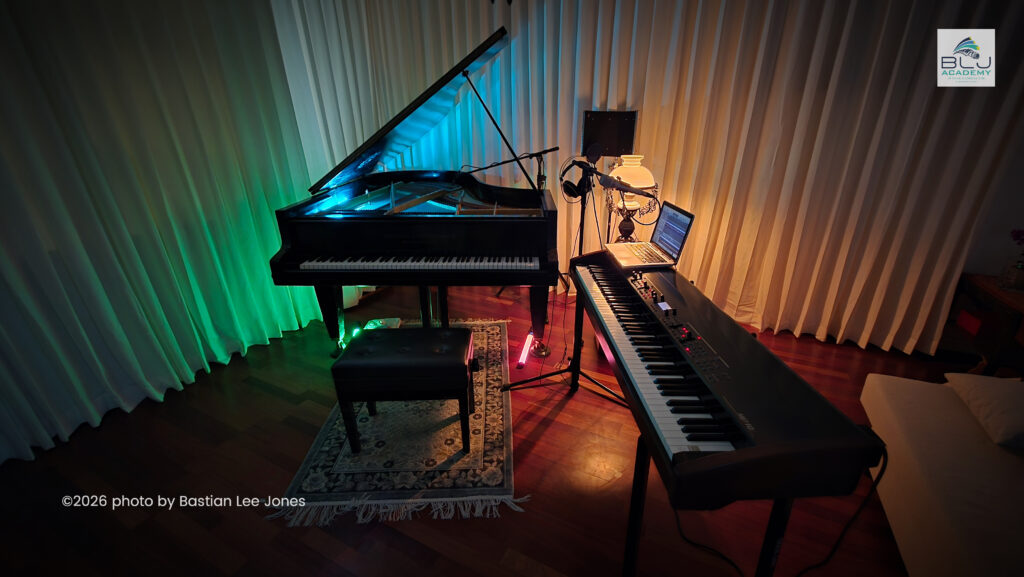
At the BLJ Academy of Music & Creative Arts™, instruments are more than tools. They are part of teaching, laboratories for sound, witnesses to history and starting points for musical thinking.
Instruments as Part of Teaching
A piano can teach far more than pitches, fingering and repertoire.
It teaches weight, movement, the development of sound, resonance, dynamics, articulation and musical imagination.
Digital instruments open up a further dimension: sound can be modified, layered, recorded and analysed.
That is why different types of instruments stand alongside one another at the BLJ Academy.
Not as a technical collection, but because each instrument makes different musical questions audible and tangible.
Kawai MP9500 & MP10
Where Piano Touch Meets the Sound Laboratory
The Kawai MP9500 and MP10 stage pianos are among the central teaching instruments at the BLJ Academy.
Their wooden-key actions allow detailed work on touch, weight, control, repetition and dynamics, providing a playing experience closely informed by the mechanics of an acoustic piano or grand piano.
At the same time, they offer additional possibilities in teaching.
They are always ready to play and do not require tuning. Different piano and instrument sounds can be compared directly. Sounds can be combined, layered and deliberately modified.
The electronic instrument therefore becomes not a replacement for the grand piano, but a musical and educational perspective in its own right.
What Actually Happens to a Sound?
An electronic instrument makes it possible to hear that a sound is not simply “there”. It begins, develops and fades away.
How quickly does a note begin? How does it change after the initial attack? How long does it remain audible? And how does it fade?
These stages can be explained and heard directly through the so-called ADSR envelope lassen sich diese Phasen unmittelbar erklären und hören:
Attack – how quickly a sound begins.
Decay – how the sound changes after the initial impulse.
Sustain – the sound level maintained while a note is held.
Release – how the sound fades after the key is released.
Effects, too, can be more than theoretical concepts during lessons; they can be experienced directly:
Reverb changes the perceived space.
Delay creates repetitions separated in time.
Phasing produces characteristic movement within the sound through shifts in frequency.
Rotary simulates the principle of rotating loudspeakers, making movement itself part of the sound.
In this way, technical theory becomes an audible experience.
These relationships are not only interesting for producers. Pianists and singers can also develop a more conscious awareness of why a sound feels close or distant, dry or spacious, direct or floating.
From Instrument to Recording
The Kawai stage pianos can also be integrated into a recording environment as MIDI instruments.
A musical idea can be played, recorded, modified and combined with other sound sources. This creates a direct bridge between instrumental playing and production during lessons.
The piano, microphone, computer and smartphone are not distractions from music-making.
Used thoughtfully, they become tools that make musical development audible, traceable and reproducible.
Recordings can help us notice details, compare progress and make more conscious musical decisions. A phrase can be listened to at a slower speed, fingering can be reviewed, a vocal line compared or an original idea documented immediately.
Recording thus becomes not an optional extra, but a natural part of musical learning.
The Grotrian-Steinweg
A Grand Piano with a History of Its Own
In Bastian Lee Jones's private living space stands a historic Grotrian-Steinweg grand piano, serial number 18975, dating from 1907.
The grand piano is not a regular teaching or practice instrument of the BLJ Academy. Its significance lies instead in its history, its distinctive sound and its connection to a longstanding tradition of private musical salons.
The instrument came to Bastian Lee Jones through the von Holleben family. Visible marks in its shellac finish, its mechanism, its case and its long history of use show that this grand piano was not merely preserved over generations, but played and lived with.
Today, it belongs to Bastian Lee Jones's personal artistic environment and represents another aspect of the same musical world: tradition, interpretation, memory and the passing on of musical history.
A Story Passed Down from the Musical Salon
Dr von Holleben personally told Bastian Lee Jones about the grand piano's history within his family.
According to this account, the instrument was used in the setting of private musical salons. This was also the world in which the pianist Martha Remmert, one of Franz Liszt's master pupils and later the founder of a Franz Liszt Society, performed and worked.
Dr von Holleben also recounted that, within the family's social circle, the grand piano was used for more than making music. According to his account, people even danced on the instrument during celebrations.
The visible scratches in the historic shellac finish are therefore more than ordinary signs of use. They belong to the instrument's story as it has been passed down and evoke a time when music, social life and the private salon were closely connected.
Martha Remmert's specific connection to this grand piano is part of Dr von Holleben's personal account. Her significance as a pupil of Liszt and an influential figure in the musical culture of her time is independently documented.
A Musical Lineage: Franz Liszt
The connection to the Liszt tradition is not confined to the instrument's history as it has been passed down.
Franz Liszt also has a place in Bastian Lee Jones's own repertoire. His recording of “Liebestraum No. 3” can be listened to on Spotify.
Two distinct dimensions therefore meet on this page: the historic grand piano's connection to Liszt's pupil Martha Remmert as preserved in the family account – and Bastian Lee Jones's present-day engagement with Liszt's music through his own artistic work.
Listen to Liebestraum No. 3 on Spotify →
The Private Performance
Before the grand piano came into Bastian Lee Jones's possession, he played two very different works for Dr von Holleben in his Berlin apartment on Südwestkorso:
Chopin's Nocturne in E-flat Major, Op. 9 No. 2
and his own song
„Über’s Meer“.
“Über's Meer” took on particular significance at that moment.
Dr von Holleben had spoken about his family history, the family's connection to the navy and his plans to move to Schleswig-Holstein. The song thus unexpectedly resonated with a personal and biographical context.
The performance itself felt less like a formal audition and more like a private musical encounter – in a tradition cultivated over generations in salons, living rooms and private concert circles.
The historic Grotrian-Steinweg grand piano was later entrusted to Bastian Lee Jones.
The transfer is documented by a purchase agreement involving a largely symbolic purchase price.
It was therefore more than an instrument changing hands.
A piece of personal and musical history was passed on.
From the Musical Salon to the Living Room Concert
Years later, an old form of musical culture continued, almost without conscious intention.
The Grotrian-Steinweg once again became the centre of music-making in a private setting – this time in Bastian Lee Jones's living room.
Living room concerts, recordings and original musical projects took shape there. As part of the Berlin piano festival Piano City, this approach also became visible to the public.
In this way, a circle was unexpectedly completed:
The historic salon did not become a museum piece, but a living musical space.
The grand piano remained part of a culture in which music is not simply performed, but shared directly – in a close, personal setting, without a great distance between performer and audience.
Photographic and film documentation from this period also preserves these concerts, showing how the tradition of the private salon found a contemporary expression.
Capturing Sound Through Recording
Bastian Lee Jones received support from Thomas Anker for numerous living room concerts and recordings.
Thomas provided technical assistance, particularly with microphone placement, setting up and configuring recording equipment, and audio recording. In doing so, he helped preserve the special atmosphere of these concerts not only within the room itself, but also through sound recordings.
Recording an acoustic grand piano involves more than simply positioning a microphone. Placement, room acoustics, the instrument and recording techniques directly influence how intimacy, resonance and dynamics are heard afterwards.
Thomas was involved in Bastian's public musical work from the very beginning – long before Bastian had become the artist he is known as today. In addition to handling the graphics and design of Bastian's printed media materials, Thomas frequently took on the role of producer. Thomas has written, and continues to write, his own songs. He also has many literary ideas and a deep understanding of how to bring them to life. When working on his music and musical ideas, he often turned to Bastian, either as a singer or as a pianist.
Thanks to Those Who Helped – and to the Audience
Music rarely comes into being alone.
My thanks therefore go to everyone who supported and helped shape the living room concerts, recordings and projects – technically, musically or simply through their presence.
They also include students and former students such as Leon Glauning, whom I had the pleasure of accompanying at the piano for many years. Leon continued to develop his own musical path, later studied jazz and now releases his own music as a songwriter and artist.
And, of course, the audience is an essential part of these concerts: people whose laughter, comments, reactions and applause can still be heard on some of the live recordings today.
They were not merely listeners – they were part of the moment.
Music That Lives On Through This Grand Piano
The Grotrian-Steinweg was not only part of private concert experiences. It was also used for recordings and musical projects by Bastian Lee Jones.
These include the as-yet-unreleased solo piano project
sweet imperfections I
featuring classical works, original compositions and selected pieces that bring different musical worlds together.
A particular role is played by Elton John's “Song for Guy”The piece forms a musical bridge to
sweet imperfections II / Livingroom Concerts II,,
einem später veröffentlichten Projekt, das die Atmosphäre der Wohnzimmerkonzerte mit eigenen Songs weiterführt.
In this way, the historic grand piano once again became part of a living artistic process:
Not as a museum object, but as an instrument for interpretation, composition, recording and personal musical development.
The recordings also show how past and present can continue to meet through the same instrument.
Listen & Watch
Part of this story is not only described, but also documented through sound and images.
Franz Liszt – Liebestraum No. 3
One of the classical recordings of Bastian Lee Jones on Spotify.
Frédéric Chopin – Nocturne in E-flat Major, Op. 9 No. 2
One of the works Bastian Lee Jones performed for Dr von Holleben.
Blue Hotel
An example from the world of the living room concerts and music-making in a private setting. I am particularly grateful to Thomas Anker for the post-production of the living room concert videos.
Instruments That Live On. Music That Is Passed On.
Anyone who would like to get to know the BLJ Academy, its teaching approach and its sound worlds is welcome to arrange a personal introductory meeting.
Alternatively, you can send a short message via WhatsApp: +49 177 7111516.